
Logs Locations
Pyramid supports both individual and enterprise deployments and can run across multiple servers and services. Various logs are generated to help administrators monitor system activity, investigate errors, and troubleshoot performance or installation issues.
Below are the different types of Pyramid logs, how to access them, and their default locations on Windows installations.
Pyramid Admin Console Logs
These logs are stored in the Pyramid repository and can be accessed through the Admin Console.
The following log types are available:
- System Logs - Record application errors, warnings, informational messages, and diagnostic events. Logging levels range from Level 0 (default) to Level 4 (Trace). Debug and Trace logging should only be enabled when required for troubleshooting.
- Entry Logs - Record user logins, failed login attempts, and formal logouts performed through the application.
- Transaction Logs - Record queries executed by users against data sources, helping administrators investigate query performance and usage.
- Benchmark Logging - Provides additional performance information for transactions, helping identify where processing time is spent. Benchmark information is accessed through Transaction Logs when benchmark logging is enabled.
- Static Shares - Records emails sent using the Send Export functionality.
- LLM Logs - Records chatbot queries, including requests and responses. Additional diagnostic information can be collected by enabling Detailed LLM Logging.
- Solve Logs - Records the execution of Solve algorithms in the application.
- Purged / Deleted Items - Provides information about objects and items deleted from the system.
- Audit Trail - Tracks changes to supported objects, including creation, modification, and deletion. Audit information is accessed through the relevant object management screens.
To access the logs:
Admin Console >> Logs >> Select the required log type (System, Entries, Transaction, LLM, Solve, Static Shares, etc.).
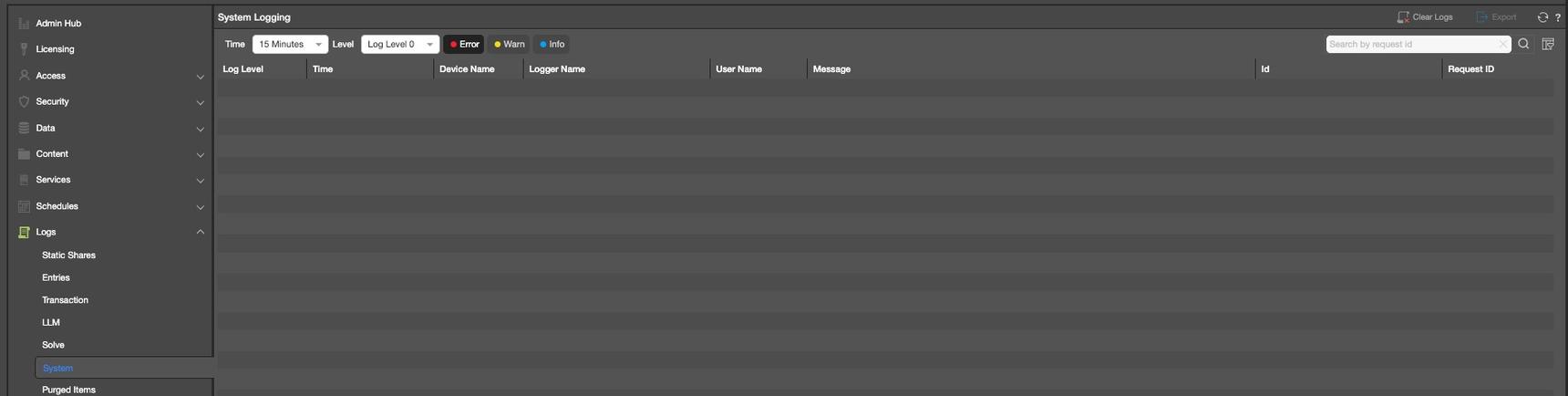
Important: Always select the correct time frame when filtering logs. For example, the System Logs page defaults to displaying events from the last 15 minutes. Older events will not appear unless the time filter is adjusted.
Logs can be filtered by time and other available fields. System Logs can also be searched using a Request ID.
Configuring logging:
Admin Console >> Logs >> Log Settings
From Log Settings, administrators can enable or disable different logging types, configure retention periods, and purge stored logs. Remember to click Apply after changing settings.
Important: Increasing system logging levels or enabling Benchmark, Trace, Debug, or other detailed diagnostic logging can significantly affect performance. These options should normally only be enabled when investigating an issue.
For more information, see: Pyramid Logging Documentation and Log Settings .
Server / Service Logs
In addition to the logs available through the Admin Console, Pyramid services generate log files on the servers where they are running.
These files can contain more detailed information than the System Logs shown in the Admin Console.
Examples of services generating logs include:
- DNC (Dot Net Connector) - Used for connectivity to supported data sources, including OLAP sources.
- Runtime Engine - Generates logs relating to runtime processing and query execution.
- Task Engine - Generates logs relating to background processing, schedules, and tasks.
Location:
On a standard Windows installation, service logs are stored in the log directory under the Pyramid installation folder.
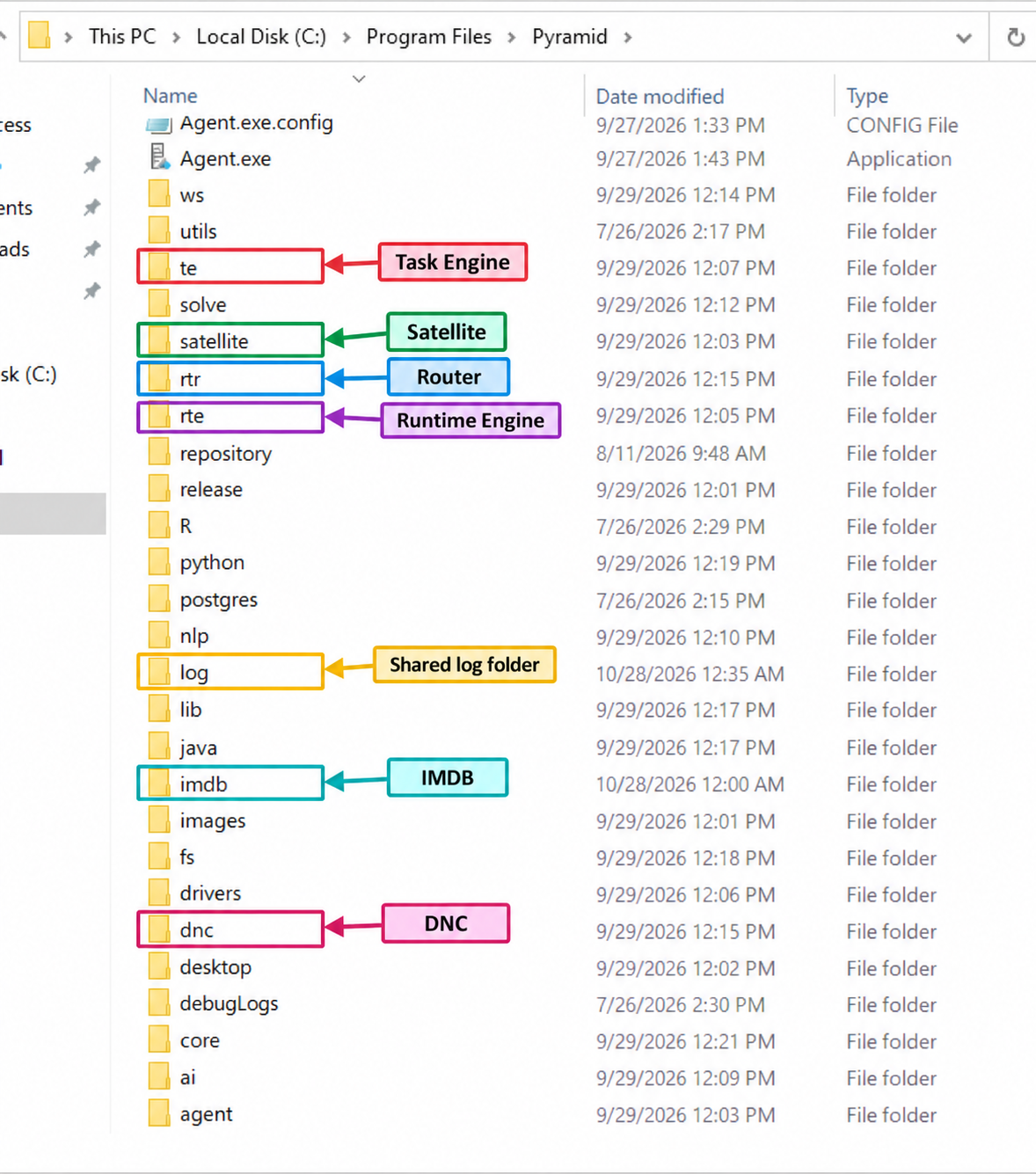
C:\Program Files\Pyramid\log
In a distributed deployment, check the log directory on each server hosting the relevant Pyramid service.
If Pyramid was installed in a custom directory, adjust the path accordingly.
Satellite Logs
Satellite processes generate their own logs, which can provide additional information when investigating Satellite-related issues.
Default Windows location:
C:\Program Files\Pyramid\satellite\log
IMDB Logs
The Pyramid In-Memory Database (IMDB / IRDB) generates its own log files, which can assist in investigating database-related issues.
Default Windows location:
C:\Program Files\Pyramid\imdb\irdb.log
Check the server hosting the IMDB service. The location may differ if a custom installation path has been configured.
Limiting the Size of Local Service Logs
Pyramid services that use Logback can be configured to limit the amount of disk space used by archived log files.
Log rotation and retention settings are defined in the relevant service's logback.xml file.
Important: Before making any changes, create a backup of the existing logback.xml file.
Example - Task Engine:
On a standard Windows installation, the Task Engine logging configuration is located at:
C:\Program Files\Pyramid\te\conf\logback.xml
In the current Task Engine configuration, the following log files are defined:
tasksengine.logmethod.logdirect.log
Each log uses a rolling policy to create daily archived files and retain up to 30 days of history.
To limit the combined size of archived files for one logging appender, locate its rollingPolicy section.
For example, the Task Engine logging configuration includes the following:
<rollingPolicy class="ch.qos.logback.core.rolling.TimeBasedRollingPolicy">
    <fileNamePattern>${log.dir}/tasksengine.%d{yyyy-MM-dd}.log</fileNamePattern>
    <maxHistory>30</maxHistory>
</rollingPolicy>
To limit archived logs to a total of 1 GB for this appender, add totalSizeCap:
<rollingPolicy class="ch.qos.logback.core.rolling.TimeBasedRollingPolicy">
    <fileNamePattern>${log.dir}/tasksengine.%d{yyyy-MM-dd}.log</fileNamePattern>
    <maxHistory>30</maxHistory>
    <totalSizeCap>1GB</totalSizeCap>
</rollingPolicy>
The same setting can be added to the rolling policies for method.log and direct.log, if required.
Note: The totalSizeCap setting applies separately to each rolling policy. For example, configuring 1 GB for three appenders allows approximately 3 GB of archived logs in total. This setting does not limit the size of the currently active log file.
If you also need to limit the size of individual active log files, a size-based rolling policy is required. For example:
<rollingPolicy class="ch.qos.logback.core.rolling.SizeAndTimeBasedRollingPolicy">
    <fileNamePattern>${log.dir}/tasksengine.%d{yyyy-MM-dd}.%i.log</fileNamePattern>
    <maxFileSize>100MB</maxFileSize>
    <maxHistory>30</maxHistory>
    <totalSizeCap>1GB</totalSizeCap>
</rollingPolicy>
This example configures size-and-time-based rotation, with a 100 MB rollover threshold, 30 days of history, and a 1 GB cap for archived files.
Important: Do not simply add maxFileSize to an existing TimeBasedRollingPolicy. The rolling policy must support size-based rotation, and the filename pattern must include the index placeholder (%i).
Changes to logback.xml should be performed during an appropriate maintenance window. Restart or reload the relevant service if required, and verify that logging continues correctly.
To configure logging for another Pyramid service, locate and review that service's own logback.xml file. The file locations and logging appenders can vary between services and deployment types.
Note: These settings control local Logback-managed files. They are separate from the repository log-retention settings configured through the Pyramid Admin Console.
Installation / Upgrade Logs
Pyramid installation and upgrade logs are useful for diagnosing installation failures and upgrade issues.
Default location for traditional Windows installations:
C:\Users\<user_name>\AppData\Local\Temp
Alternatively, open the Windows Run dialog (Windows + R), type %TEMP%, and press Enter.
This opens the temporary folder of the currently logged-in Windows user.
Replace user_name with the Windows account used to run the Pyramid installation.
Depending on the installer version, look for the following log files:
installerbuilder_install.logpyramidinstaller.log
There may be multiple files from previous installation or upgrade attempts. Sort the files by Date Modified to identify the logs associated with the latest attempt.
Installer log filenames and locations may differ according to the Pyramid version and installation method.
Additional Information
When investigating an issue, Pyramid Support may request logs from more than one server or service.
Where possible, provide the following information together with the logs:
- The Pyramid version and build number.
- The approximate date and time of the issue.
- The affected server and Pyramid service.
- Relevant error messages or Request IDs.
- Steps to reproduce the issue, if applicable.
For more information, refer to the Pyramid Admin Console Documentation .
Reply
Content aside
-
1
Likes
- 4 yrs agoLast active
- 566Views
-
1
Following